

 See why 4thWay now accepts ethical ads.
The 13 Key Peer-To-Peer Lending Risks
When it comes to the risks of losing money, the main peer-to-peer lending risks are:
- Yourself (psychological risk).
- Not enough diversification (concentration risk).
- Losing money due to bad debts (credit risk).
- Losing money due to a P2P lending site going bust (platform risk).
- Losing money due to a solvent wind down (more platform risk).
- Losing money due to fraud or negligence.
- Selling into a loss (crystallising losses).
- Losses because you can’t sell early (losses from liquidity risk).
- Lost capacity to earn from unlent money (cash drag).
- Reduced real earnings due to inflation (inflation risk).
- Reduced earnings due to legal or tax changes.
- Losing money from foreign currency fluctuations (currency risk).
- Losing money through cybercrime.
Introduction: how big are the risks of peer-to-peer lending?
From 2005 until the beginning of 2026, the P2P lending industry has shown individual lenders just how stable and resilient it is.
Easily surviving the Great Recession and financial crisis of 2008. Providing remarkably sturdy returns after the 1-in-300-year pandemic recession of 2020 and beyond, through the lockdowns in 2021, high inflation in 2022 and worker shortages in 2023 and 2024.
Indeed, P2P lending has returned an average 7.72% per year after costs and bad debts, with no losing years and only being beaten by inflation in one year.
Plus, while investing in shares remains a fantastic part of anyone’s portfolio, P2P lending has also, nevertheless, outperformed the stock market by a big margin.
Even so, despite our best efforts across many pages and research articles, and well over 100 citations in the major national press, not quite all 4thWay users have been prepared for some of the inevitable peer-to-peer lending risks and taken sufficient action to protect themselves.
The key information you need to deal with the risks has always been in this guide you’re reading now, since 4thWay started in 2014, with only modest updates over the years.
We want to continue to help more 4thWay users understand and manage P2P lending risks. Please allow us to really ram home to you what the risks in P2P lending are all about, and how to minimise them.
This will help you be confident in your lending strategy and ensure you don’t react the wrong way during the bad times.
The 13 categories of P2P lending risk
The key peer-to-peer lending risks that might lead to losing money can be placed into 13 different categories. Here is a list in priority order and some simple but highly effective ways to minimise those risks.
P2P lending risk 1: yourself (psychological risk)
When you ask “How risky is peer-to-peer lending?”, the answer often comes down to how much you step back, calm down, and look at the facts, when making lending decisions.
Good investing is usually fairly simple, so any problems are usually down to our own behaviour, attitude and temperament.
So, the biggest risk in peer-to-peer lending – as with every kind of investment since forever – has always been what happens in our own noggins: we get greedy when we should be cautious; we’re afraid when we should be confident. And we convince ourselves we know everything, when we don’t.
We call all this “psychological risk”.
Greed
Greed is the big one and we’ve seen this to be the case in P2P lending already. You observe that you could earn a highly attractive lending interest rate and you want it so badly that you’ll do anything to convince yourself the investment is a safe bet.
Sometimes you really can earn exceptionally high interest rates with well-contained risks, but this is not usually the case.
In a P2P lending context, being greedy usually means putting all your P2P investing pot into just one or two lending accounts that advertise high lending rates. Often, you do so without much thought or research.
Too clever by half
In share investing, the vast majority of people who actively try to pick and choose investments, buying and selling frequently to get an edge to boost their returns – they actually do substantially worse than others who invest more passively from a distance.
The same happens in P2P lending, but to a lesser extent. That’s because 1) prices of loans are often fixed for buying and selling (e.g. a loan part that was to the borrower for £1,000 is usually bought and sold for that same face value), 2) you sometimes have no “frictional costs” (such as fees to the P2P lending provider for any trades you make) and 3) because there’s a lot less reason to trade regularly.
Yet it’s still one of the psychological risks of peer-to-peer lending, and a big one. For example, it’s easy to get overconfident and select just a handful of high-paying loans to pile your money into.
It doesn’t help that nationally renowned money and investing experts have recommended “dipping your toe in” as a way to get to see if a P2P lending account is any good.
The dip-your-toe-in technique is a ridiculous way to ascertain whether any investment has the right risk-reward balance for you. Just because it doesn’t go wrong in the first few months, it doesn’t mean it won’t later on.
Dipping your toe in teaches you nothing about the fundamental risks or whether the interest rates cover those risks.
Overestimating your knowledge is a big psychological danger. A little knowledge, as the saying rightly goes, can be dangerous. You’re overconfident that things will be plain sailing.
That applies to people a lot smarter than me. I’ve seen engineers, mathematicians and accountants lose serious amounts of money when investing. Mostly in shares, but actually in a variety of investments.
I even know a professional investment journalist who lost everything, because he didn’t follow his own excellent advice, got greedy, and put all his money into a single, losing big bet.
Don’t presume that you’re smart enough to break all the rules!
Following a crowd’s euphoria
It always goes wrong at the point where the last sceptic is saying: “This time it’s different; the stock market has gone up and up and up, and this time there will be no crash.” That’s when everything invariably collapses on all the people who got greedy, leaving sensible lenders and investors to make a big profit from what’s left.
It doesn’t happen to all investments at the same time. In the P2P world, for example, most P2P lending companies will maintain good standards.
But some P2P companies will lose their heads and their discipline, slackening their lending standards and accepting borrowers at even lower interest rates, because “nothing has gone wrong before” and because the management at some of those businesses believe they have to keep growing beyond reason to earn their bonuses.
Not all P2P lending companies have been immunie to that, so it’s a risk in peer-to-peer lending.
We’ve seen it many times before in other industries too: most recently in the sub-prime property bubble of 2008.
The problem was that banks thought: “We haven’t lost money lending to borrowers with a fat 20% deposit, so let’s make it 15%. Then 10%. Then 5%. Now 0%… Actually, we can lend more than the property is worth! And we can do so when the two incomes of the homeowners are stretched really, really thinly. Because nothing’s gone wrong before…”
CRASH!Nothing went wrong before because they had kept sensible standards. Always demand the same of the P2P lending companies you use.
This is not about the inevitable worsening returns that even good platforms will sometimes pay you during recessions and property crashes. I’m talking about the larger issues caused by lending to more and more borrowers of increasingly poor quality, without compensating enough for the risks.
Don’t get sucked into craziness like this. Be on the alert.
Fear
In a downturn, some types of lending might suffer reduced results, with a diversified portfolio getting lower gains in the period. In an absolute and total catastrophe like almost no other, it’s even possible to suffer a loss in some quality P2P lending accounts.
Lenders who don’t deeply understand that different downturns can impact different types of lending and reduce their returns a lot, and that this is normal, might be angry and sell, missing the opportunity to earn the best returns when the recovery happens.
You might even be forced to sell at a cut price if you want to get out with the crowd. Fear is a real risk in P2P lending.
“I’m soooo right! Because…”
Once you’ve put a lot of effort into researching an investment, you really don’t want to reject it. This is called confirmation bias. By really wanting to believe in an investment, you look for reasons to buy it. But a good investor should actually be looking for reasons not to buy.
Some P2P lending companies are big on sales talk, but offer very little in terms of information, data and evidence to show how good they are. Don’t ignore warning signs such as this. On the contrary: seek them out!
Summary of how to avoid psychological risk in peer-to-peer lending
All peer-to-peer lending risks have very simple ways to counter them or minimise them:
- The key way to prevent your emotions secretly nudging your decisions is to just lend in P2P lending opportunities that pass all your criteria in a checklist. You could do very well at preventing all of the risks of peer-to-peer lending if you use 4thWay’s 10 P2P Investing Principles.
- Stick to your lending rules through thick and thin – even if some P2P lending sites themselves don’t do so.
- You need to start from a sceptical point of view and ask a lot of questions. Try to destroy the idea that you should lend through a particular P2P lending account, rather than looking for reasons to lend. If you can’t destroy it, you’ve probably found a very good one – at least as part of a wider portfolio that should perform just fine when taken as a whole.
- For the bulk of your investing pot, stick to reasonably ordinary types of loans, and lots of them, and lots of different types of loans to cushion you against various different economic situations. You’ll feel safer and will be less likely to make poor decisions later on.
- Commit in advance to spread your money widely across lots of loans and lending platforms and invest regularly without trying to get that extra 1%.
- It would be a clear over-reaction to stop lending through a successful P2P lending company just because it supplies you with much reduced returns for a year or two after a major recession strikes. Sometimes, things like that happen. If you hang on, you’ll continue to earn more interest on your good loans that offset bad debts further.
- If you quit money lending altogether when it has provided such startlingly stable returns overall, that would be even more tragic. Like the stock-market investors who aren’t prepared for the fact that it sometimes has massive down years: they sell at the bottom and are not tempted back in until when it’s already risen too high again. Don’t be like that.
- Earn deserved confidence to prevent your emotions taking over. You don’t earn this confidence by getting good results for a year or two. You do so by learning about P2P lending – and keep learning to pile up your knowledge.
- The crowd can be useful in ascertaining how easy it is to use a specific lending account, how easy it usually is to keep your money lent out, and in gathering ideas on how to assess individual loans. Their input is valuable, but they don’t replace your own assessment when it comes to finding the risk-reward balance and whether the investment is actually any good. Think independently, ignore euphoric or doommongering talk – and don’t follow the crowd into disaster.
- Set some of your own standards that are easy to follow.
To expand on that last bullet, for example, for property lending you might set – and stick to – simple standards for the loans you lend in, like:
- Just lend in loans that are for less than 65% of the properties’ valuations, or 80% if the properties are tenanted and being let out with rent at least 1.25 times the total loan (mortgage) repayment on every loan.
- At least four out of every five property loans you lend in put you first in the queue (ahead of banks and other lending businesses) to recover your money in the event that your borrowers are also borrowing elsewhere and become unable to repay all their debts.
- Lending interest rates need to be several percentage points above the best savings rates.
Accept no imitations!
The list of 13 risks continues below. Please allow this brief interlude, because large parts of this page have been copied by other websites. Those websites sometimes end up ranking higher than us in google search results with our content!
4thWay is a frequent target of plagiarism, because our specialists with serious, diverse backgrounds lead the field of P2P lending with high-quality, 100% original research, including interrogations and data analytics. It costs a lot of time and money to do what we do.
Plagiarism is often only partial, so that copyright thieves can better cover their tracks, but this means that they leave out important facts or re-write our material inaccurately. That puts risks on you as lenders as well.
Please support 4thWay and get the best content by subscribing to us and by donating.
P2P lending risk 2: not enough diversification (concentration risk)
If you lend to one borrower, it might not matter how brilliant the P2P lending site is at assessing loan applications, you could get unlucky and lose lots of money. This is called “concentration risk”, although I’d probably also call it “rookie mistake number 1”.
Avoid concentration risk of peer-to-peer lending with lots of loans
Across your entire portfolio of P2P lending accounts, you must spread your money across lots of loans. This is the absolute central pillar in good peer-to-peer lending risk management.
The impact of breaking your money into small parts like that is simply incredible. Spreading your money across dozens of prime property loans, and potentially hundreds of small personal or business loans as well, reduces the risk of suffering severe losses from bad debts to a minuscule fraction of the risk compared to lending to just one borrower.
We’re not kidding. The maths is mind boggling how the risk shrinks when spreading your money around. 4thWay’s most senior risk specialist has helped build many datasets from banks and P2P lending companies over 30 years that demonstrate this, 4thWay has collected a lot of data showing it remains true in P2P lending, and public records also show how stable money lending can be with lots of loans.
The more secure and solid the type of lending, the fewer loans you need, but you always need to diversify.
Another absolutely essential way to avoid concentration risk
Also, spread your money across several peer-to-peer lending sites. This doesn’t just reduce the risk of suffering losses from bad debts; it also reduces all other peer-to-peer lending risks on this page.
Don’t concentrate all your money on the bad debts
Hand in hand with spreading your money widely is the amount of time you lend for. By holding your loans until they’re all repaid by your borrowers, you earn all the interest you can out of your good loans, while allowing time for some of the bad debts you suffer to be recovered.
The benefits of doing that show mostly when a type of borrower, or a specific lending account, goes through a bad patch; for example due to poor economic conditions for those particular borrowers. You see the number of loans that are being chased as bad debts rise and the impulse can be to sell what you can immediately.
But normally you’re only able to sell your loans that are in good standing – the ones most likely to pay you interest to cover any upcoming write-offs. If you are left just with bad debts, your chances of losing money after interest rises dramatically.
A few kinds of lending (e.g. personal lending or non-property loans to small businesses) typically see the bad loans reveal themselves early on. So, within a few months of lending, a good chunk of all the loans that will ever go bad have already done so.
But, at that point, you haven’t yet had much time to earn interest. That’s why, for these kinds of loans, the first few months can give you your worst results for the whole time you’re lending to your borrowers.
If you were to sell now, all those loans that would have paid you interest for years to come will no longer do so. The risk is that you’ve left yourself with bad debts and whatever can be recovered from those bad debts.
In other words, you’ve concentrated your lending portfolio on all the rubbish borrowers you were dealt! Don’t make this mistake. Understand the profile and characteristics of the loans you’re getting into before you start lending, so that you’re not shocked.
Concentrating your money when using auto-lend accounts
If you lend in auto-lend accounts, take the time to ask how your money is allocated.
Sometimes, your money is automatically spread across a very large number of loans.
With other auto-lend accounts, you could find that there is no automatic diversification built in. Or you might automatically lend to the same borrower many times.
With such lending accounts, the more you lend, the greater the chance that massive chunks of the money you put in will go into just a handful of over-sized loans.
Take simple steps to stop this, e.g. by dripping smaller amounts into the lending account at a time, so that the provider can’t overweight you in a small number of loans. Or just lend in auto-accounts that spread your money more widely.
P2P lending risk 3: losing money due to bad debts (credit risk)
The most “commonplace” reason for losing money on some loans is when your borrowers aren’t good enough or they suffer misfortunes.
When they can’t pay back all your money (or find some way not to, e.g. through borrower fraud), this is called “credit risk”.
A P2P lending company might recover or partially recover a bad debt, as well as interest due to you. Any bad debt amounts that aren’t recovered are called by lots of names: a loss, crystallised loss, credit loss, write-off or charge-off.
Of all the peer-to-peer lending risks that we face, this is the one which 4thWay spends the most time assessing, as it comes down to the basic competence of the people behind the P2P lending companies, their P2P lending risk management, the quality of the loans and the results of the loans.
12 years’ experience in assessing these providers also shows us that good lending practices usually translate into good management across the board, which lowers many other risks in this list, too.
There’s a lot that goes into good peer-to-peer lending risk management. P2P lending companies have varying degrees of skill and experience, and the quality of their processes vary.
They need to be conducting the appropriate checks (such as credit checks or physical inspections of properties from an independent surveyor). If they’re deliberately arranging higher-risk loans, they need to be setting interest rates higher to reflect that. They need to be carefully managing any possible conflicts of interest.
When loans go bad, you generally expect that the interest you earn from your good loans is enough to cover any losses.
Sometimes you have additional protections too. The loans might, for example, be secured on the borrowers’ properties, which means they can be more easily repossessed and sold on your behalf.
Occasionally, the P2P lending site might have a pot of money set aside to pay some of the expected bad debts. Or they might take the first loss of, say, 5%.
If enough loans go bad though, it can overwhelm all these defences. You might be left with a loss.
During recessions or other financial crises, or when a provider tries to grow too fast at the expense of quality, the risk of suffering losses in one or more of your lending accounts goes up.
Some bad debts are a certainty, but a little effort from you ensures they are highly manageable
When you talk about “risk”, it means something bad that might happen. In a sense, bad debts are not a P2P lending risk, because you’re certain to suffer some bad debts, some of the time. Accept the fact that they will happen.
What’s important is that you’re not at all certain to make an overall loss. Indeed, you’re exceptionally likely to earn an overall profit if you follow simple lending strategies. Those strategies minimise bad debts and make them less volatile.
The risk of making an overall loss or a large loss in money lending is substantially lower than the stock market. And that is even during recessions.
How to minimise credit risk in peer-to-peer lending
- Many peer-to-peer lending risks are minimised by spreading your money widely across hundreds of loans and many P2P lending accounts. This is especially true for credit risk. Here’s a simplified example: if one-in-20 loans typically turns bad in good economic conditions, and you lend in 200 such loans, you usually have just a 0.1% chance of suffering twice the typical bad debts, i.e. suffering two bad debts in every 20 loans. However, if you lend in just 20 such loans, the chance of suffering at least twice the typical bad debts rises to 26%!
- As mentioned earlier, you also need to keep lending until your good loans are repaid in full with interest, and allow time for any recoveries to be made on bad debts.
- Ensure that your money is also spread across different kinds of loans and borrowers, because each downturn has different impacts on the various types of borrower or loan. You don’t want all your money in the hardest hit area.
- The rest comes down to selecting high-quality P2P lending accounts. You could start using the P2P lending reviews in our comparison tables and by learning more about assessing P2P lending accounts in 4thWay’s guides.
P2P lending risk 4: losing money due to a P2P lending site going bust (platform risk)
We’re now getting into lesser risks in peer-to-peer lending, in that they will impact fewer people. But individuals lending money in these events could still sometimes lose a good chunk of the money they lent.
When providers close, for any reason, it can cause delays or increase the risk of losses. That’s called “platform risk”.
P2P lending risk 4 is about a particular kind of platform risk. It’s about the risk of losses due to peer-to-peer lending sites and IFISA providers going bust.
Formally, that’s called “insolvency” and it means they can’t pay their bills and debts. Bankruptcy, for example, is one form of insolvency.
In these cases, useful for containing any potential losses has been the fact that your lending is usually ringfenced.
That means that you and other lenders are protected from having repayments from your borrowers being diverted to pay off the bust provider’s own debts, such as their own bank loans or outstanding supplier invoices.
Furthermore, you do still often receive interest payments from borrowers during the wind down, which can reduce negative impacts on you.
However, despite all that, lending results after going bust have historically been very poor.
A large number of providers – it could easily be more than 100 – have come and gone over the years in the UK alone. Most of those closures were benign. But seven of them notably went bust.
One of those seven wasn’t bankrupted till long after it had exited the P2P lending space. But the other six ended disastrously for lenders.
Lenders in those six providers lost (or will lose) a high proportion of the money they lent.
Bust providers have tended to have the worst lending results in the end
Mostly, those losses are linked to the quality of the loans. So, in reality, those losses are not down to bankruptcy of the provider but largely down to “P2P lending risk 3: losing money due to bad debts (credit risk)”.
It’s just that most lenders only understood how dreadful the loans were after the business went bust.
The simplest clue was that those providers were all opaque and secretive.
If you choose to make a commitment not to lend to providers that don’t give you a huge amount of information and data about their loans, you avoid such problems.
Lenders carry the high cost of winding down bust businesses with awful loans
The losses from bad debts that lenders have suffered from those bust providers have been compounded by the high cost of winding down the bankrupt businesses and their ongoing loans.
Specifically, specialist businesses called “administrators” or “receivers” are appointed to do this dirty job. They’re usually very slow and they’re always very expensive.
Lenders typically end up paying a large chunk of the administrators’ fees – which further increases lender losses.
Some special circumstances during a wind-down might increase the chance of losses on individual loans
There will be the occasional issue specific to the P2P lending company that is closing down that can create specific risks.
For example, if lenders have been funding developments in tranches, an ongoing property development might suddenly be unable to raise the remaining money needed. The borrower’s project might be delayed. This increases the risk that the development site can’t be completed, or the property sold at a price that covers the amount lent so far.
Wind-down plans: a new defence that might mean better results from bust providers
Since those seven UK-based providers went out of business or left the P2P lending space, the financial regulator created new requirements for businesses operating in this space.
Most providers now have to produce wind-down plans for when they are closing down. The Financial Conduct Authority reviews these plans every year and it’s committed to strengthening this further over time.
The cost of the wind-down needs to be fully funded in the plans, with at least £50,000 in cash set aside in advance to fund the wind down. This amount rises the more money that is being lent.
The plans should consider how they intend to keep their regulatory permissions (and if necessary their IFISA status) when closing until the loans are repaid, and how they’ll retain enough knowledge and skill in the business to support that.
It should also explain how cash in your lending accounts will be handled.
However, the bulk of lending losses after closure in bust providers has to a large extent been down to bad debts (risk 3) and not directly down to the fact the provider became insolvent. Therefore, you shouldn’t expect that wind-down plans will nullify your losses here.
They will likely improve your results though. The planning and funding should reduce any hit you take from the high costs of winding down the loans when an (expensive) insolvency administrator steps in.
These new rules on wind-down plans apply to providers that use “article 36H” agreements between the borrowers and lenders. Those are the bog-standard “P2P agreements” and most platforms using these describe themselves as P2P lending platforms.
Some providers use alternative legal structures to enable direct agreements between borrowers and lenders. Or they use legal devices that create exactly the same effect. These providers are not always covered by a requirement for wind-down plans.
To further reduce your risk of losing money from a bust P2P lending site
- Look out for reports that the P2P site appears to be either profitable, well funded, or well backed by investors or a parent company.
- Most of the seven that went bust were never rated by 4thWay. And none were rated by 4thWay within 12 months of the cracks beginning to show publicly. Plus, we either were explicitly negative on them or implicitly negative in that they were so opaque that we couldn’t assess whether they offered a good risk-reward balance – which is an automatic “No” to lending through that provider.
- Lenders who had been following 4thWay’s 10 P2P Investing Principles rigorously should have had no funds being lent through those bust providers.
- If you’re familiar with company accounts, there can be small, indicative nuggets or even solid reassurance in those, even in the case of private businesses, which put less information in their accounts than public (stock-market) companies. Not much value by themselves, but potentially as part of the bigger picture.
- Look into whether the lending site really does do direct lending. Some websites that describe themselves as P2P do not actually offer direct, ringfenced lending, but 4thWay only lists sites that appear to offer that kind of genuine, “pure” P2P.
- Lend across several different P2P lending sites. If, for example, one out of six of the P2P lending companies you use both goes bust and – very unfortunately – just returns 60p in the pound (after prior interest earned), that’s probably still less than just one year’s interest across your entire portfolio. A bad result – but not as terrible as a bad year on the stock market.
P2P lending risk 5: losing money due to a solvent wind down (more platform risk)
Most companies that close their P2P lending platforms don’t do so because they are going bust.
While there have probably been over 100 providers in the UK, the majority of those closed probably before they even approved their first loan. It’s normal with any kind of investment for a lot of entrepreneurial attempts to be aborted at an early stage like that.
4thWay’s own database counts 31 notable providers that closed their P2P lending operations or shut down completely, without going bust. These are “solvent” wind downs.
Such providers closed for a variety of reasons, including:
- They sold their businesses to banks, which have taken on their borrowers and teams, but had no remaining use for P2P operations.
- The owners and directors decided their lending niche was too difficult to sustain or grow for the long run, so closed rather than struggle on.
- The structure they had arranged for the lending accounts were inhibiting them from living up to all lenders’ expectations. Perhaps because of over-optimistic claims about the chances lenders would have of being able to sell their loans early.
- A strategic decision was made to shift to a different, non-P2P lending business model. (Many P2P lending companies are born from non-P2P lending business that shifted into P2P, too!)
On closing, all of these, so far, have repaid lenders back at least the value of their initial loans. Usually, lenders also earned an awful lot of interest, so ended on a positive note.
Occasionally, solvent wind-downs have seen lenders earn somewhat reduced lending returns in those closing months or years, but that has primarily been due to bad debts, which is covered in a previous risk in this list.
However, in one case that is still ongoing, a P2P lending company started charging lenders additional fees, reducing their overall returns in the final years.
That P2P lending company still expects lenders to make overall positive returns on those loans, and the last dataset we received from them supported that scenario. However, a large increase in fees makes it more likely that lenders will suffer losses, because you have less interest cover.
And that’s besides the annoyance of suddenly being hit by those fees. The reason given for the fees and the wind down was that the business wanted to switch to a different lending model.
Thus, a strategic shift away from being a P2P lending company can potentially lead to greater risk of losses, even if the business is otherwise very sound and loans are performing roughly as expected.
Some providers that closed their P2P operations repaid lenders early in full, shortly after they closed. Most instead lock you in until the borrowers have repaid. You should presume in these cases that you will no longer be able to sell your loans early, if you had previously had the option to do so.
Ringfencing is a key defence for you here
The amounts you lent should be ringfenced and therefore paid back to you when borrowers repay. The business can’t take those repayments to pay its owners while they close down. Nor can it put them into other products and services if it is changing direction.
Wind-down plans will largely be effective during solvent wind-downs
Even without wind-down plans being demanded by the regulator, providers that closed their P2P lending platforms in the past without going bust have left lenders doing fairly well in the end.
Wind-down plans still are very useful in a solvent wind down. And not just for the same reasons explained in Wind-down plans: a new defence that might mean better results from bust providers.
In solvent wind-downs, if the wind-down plans are reasonable, a P2P lending site should be able to continue to administer and collect on existing loans smoothly, repaying you until all the loans are cleared.
Assuming the company has just been unsuccessful or is tilting its business in another direction, but otherwise had fair quality loans, providers can usually streamline their costs in wind-down mode.
Some of the big costs in P2P lending are the sales and marketing costs to attract borrowers and lenders, as well as the process of assessing borrowers to see if they’re worthy of a loan. You can typically expect both these costs to disappear instantly in a P2P lending site that is winding down.
While smaller operations are – perhaps – at greater risk of not surviving for the long run, their costs are usually so low that even the founders alone have been able to hang around long enough to monitor and wind down the remaining loans.
Reducing risk of losing money in a solvent wind-down
Look to their plans. Providers that are required to have wind-down plans should also share at least an abbreviated version of them with you for you to investigate. The quality of information you get publicly still varies though and is often very terse. (Read What Do We Make Of The P2P Lending Companies’ Wind-Down Plans?)
Look to signs of great integrity at the P2P lending companies. Hone your antennae regarding so-called “moral hazard”, which are signs that the people operating the businesses are more likely to leave you in the dirt if they decide to close or shift their businesses.
It’s easy for us to say, since we have direct access to key people and interview them, but there’s quite a lot you can attempt to do from home in this regard.
Signs of moral hazard can include reading stories, articles and blogs about or by these P2P lending companies that too often have a large emphasis on their business’ own revenue growth or the funds it’s raised from its shareholders. This can potentially indicate a lot more interest in getting rich than in helping small investors and lenders.
Another potential sign is extremely rapid growth in the volume of lending it does. Or a constant shift in the types of loans available, as the provider potentially agrees to loans outside its experience in order to earn fees.
You can look to the volume and type of decisions made against the P2P lending company by the Financial Ombudsman Service in its register, here. (See also our summary in How P2P Lending Providers Stack Up On Ombudsman Complaints.)
Pay close attention to your instincts if they warn you about the personalities of the people in charge at the provider. Don’t be dismissive of your feelings.
No sign of moral hazard is conclusive by any means, but, the more you see (or feel), the less you might want to put into such a P2P lending company.
P2P lending risk 6: losing money due to fraud or negligence
All types of saving product or investment, from the stock market to property to savings accounts and beyond, attract some fraudsters or even people who commit criminal (or near-criminal) negligence. P2P lending in the UK is no different, even though it has been very rare.
In the UK, while fraud and serious negligence will occur far less often than P2P lending sites simply going bust, the losses you’ll make if you’re sucked in by scammers or chancers are likely to be much bigger.
As with reducing bad debts, it’s down to the companies to ensure they have effective fraud risk management and good governance.
How to avoid fraud risk in peer-to-peer lending
There are usually many tell-tale signs, making this risk easy to dodge, almost all of the time. Some really big signs that you’re being targeted as a potential victim are:
- No entry on the Financial Conduct Authority’s register.
- Not showing on prominent websites such as 4thWay.
- No opportunity to contact them by telephone.
- No secure website. (No “https”, with an “s” on the end, in the website address bar.)
- Highly aggressive marketing language, i.e. talking down the risks while talking up glittering rewards.
- You’re cold-called, feeling rushed or feeling pressure to make a decision to hand over your details or money.
For more complete checklists, read Fend Off Peer-To-Peer Lending Fraud & Incompetence. In addition, follow 4thWay’s 10 P2P Investing Principles to seriously reduce the chances of being hit hard by any of the 13 P2P risks. You might also read How To Check The Financial Services Register For Monsters.
How the FCA lowers fraud, negligence and other P2P lending risks
The FCA does a lot of work to screen out applications to run a P2P lending company. Most of the applications don’t fail because of malign intentions, but for other reasons.
Still, to an extent, the FCA’s application process keeps out fraudulent P2P lending companies. To a greater extent, it also reduces (but doesn’t eliminate) the number of P2P lending companies that launch and go on to be negligent or highly incompetent:
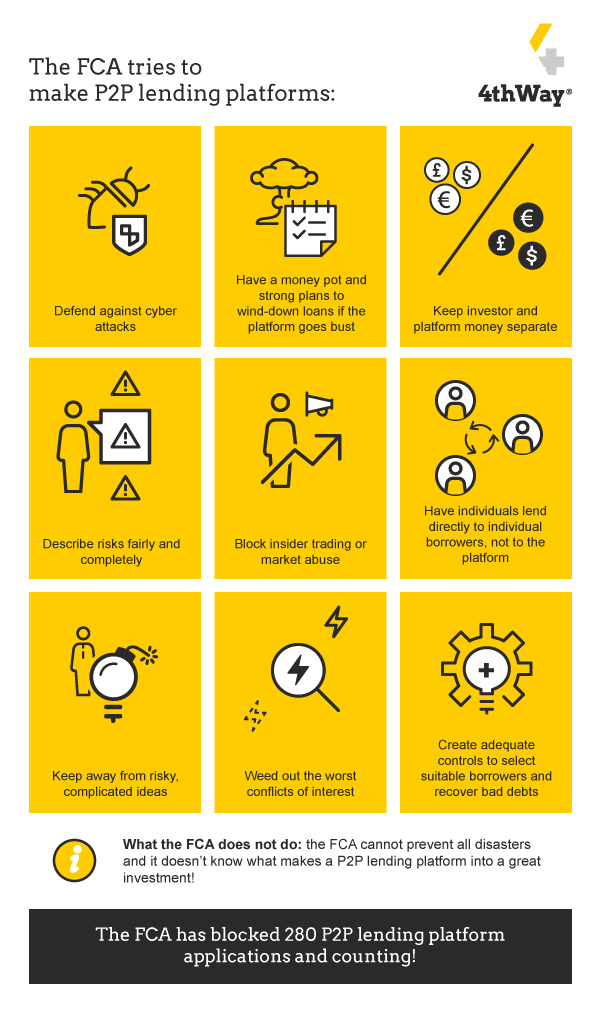
Click to enlarge.
P2P lending risk 7: selling into a loss (crystallising losses)
Most P2P lending providers won’t let you sell your loans unless they’re in good standing. That means that the borrower is on track with payments and hasn’t breached any important conditions in the loan contract.
However, some will let you sell impaired loans, provided you sell for a cut price to reflect the current risk on that loan. This means that if you suddenly panic and sell all your loans, including the bad ones, you’re basically taking the decision to turn paper (and often temporary) losses into real losses. This is called “crystallising losses”.
Some P2P lending companies also charge early exit fees if you sell to other lenders rather than wait for borrowers to repay, which would add insult to self-injury.
The risk is higher if you combine it with peer-to-peer lending risk 1, psychological risk – if you panic during a severe recession perhaps. Both losses and the proportion of loans that get into difficulty climb in a recession, so you’ll sell many more loans at a loss when they might have recovered more, given time.
How to avoid the risk of crystallising peer-to-peer lending losses
When a provider actually allows you to sell loans that are currently bad, you especially need to understand and believe in the provider and the quality of the loans. So only lend through such lending accounts when you’re highly confident in your chosen investments.
I’ll be honest with you, experience shows that many lenders who appear calm and really believe they are confident in what they are doing still panic sell (see risk 1) in these circumstances.
Therefore, when choosing lending accounts, consider selecting some that don’t allow you to sell your loans to other lenders at all. This enforces discipline on you; you’ll have to wait until borrowers repay in full – with interest – regardless of what your emotions are telling you to do.
P2P lending risk 8: losses because you can’t sell early (liquidity risk)
The ability to sell your loans early – before your borrowers repay them naturally – is not a promise or a sure thing. It’s just something that you might be able to do.
Most P2P lending websites offer the ability to sell your loans early and most of the time it works out reasonably well, but it’s far from a guarantee. Selling early doesn’t always work out. This is called “liquidity risk”.
This is an inherent quality of money lending that you absolutely need to fully understand before you get started. There’s usually no point getting angry with P2P lending platforms that become illiquid for a time, because it’s part-and-parcel of this form of investment.
When you can’t sell to other lenders, your loans still accrue interest and the borrowers are still obliged to repay, so it’s not the end of the world.
But it could be a disaster if you’d lent your money hoping to take it out again just a few months later for a deposit on a house. You might find that you lose money by not being able to buy at the right time.
That is one of the hidden risks in P2P lending: a loss can occur not because your loans did badly, but because of a missed opportunity somewhere else while your money was tied up.
Or you might not be able to pay a bill and the penalties outweigh the interest you’re earning in P2P loans.
Or you have to borrow money at higher interest rates while you wait for your P2P funds to come back to you.
There will be other scenarios where financial obligations might mean you need your money back in your bank account and it becomes costly for you, because you’re unable to get it on time. Lending the money you’re saving to pay your upcoming tax bill is not such a good idea.
How to avoid liquidity risks of peer-to-peer lending
Be deeply aware of when you’ll need the money you intend to lend. The more money you’ll need in the near future, the less you should put into investments, such as P2P lending.
The natural horizon for these investments is usually until the borrowers repay and all possible recoveries of any bad debts have come in. Don’t lend on the basis that you intend to fight nature, which is often impossible. Just go with the flow.
Take huge comfort in the fact that the flip side to illiquidity is stability. Peer-to-peer lending returns are very stable because the interest rates are priced at the beginning and then lenders hold onto loans until borrowers repay.
If P2P lending instead became like the stock market (it won’t), it would mean wild price swings. People dip in and out all the time in shares and it causes a lot of volatile prices.
If the same happened when lending, it would mean you might have to pay more than the loan is worth. Or, when you sell, you’d have to sell for less than it was worth. Since prices are usually fixed or nearly fixed, this happens a lot less in money lending.
For more tips on this, read 10 Ways To Get Your P2P Lending Money Back!
P2P lending risk 9: lost capacity to earn from unlent money (cash drag)
When your money is held in cash in your lending account, waiting to be lent out, you’re not usually earning any interest on it.
It’s like having it in your current account where you’re earning no interest. Even having it in a savings account paying 1% interest would be better.
Cash drag is not usually a big problem. When a P2P lending site is on a roll, just a small proportion of your money is not being lent out, so it only reduces your overall interest rate by a fraction of 1% per year.
When a P2P lending company is suffering a shortage of loans, it’s usually so obvious that you can simply move a load of money out.
Cash drag can be more frustrating when you’re lending in P2P lending companies with a minimum lending amount of £1,000 or more per loan. It can take a while for sufficient interest and repayments to come to you before you have enough to lend the money again.
How to limit cash drag
You shouldn’t be lending in accounts that have a £1,000 minimum per loan unless you’re lending tens of thousands of pounds, because you won’t be diversified enough. Once you’re lending this much money, it won’t take you long even in these accounts to earn enough interest to lend your money again.
And you’ll regularly be receiving full repayment from borrowers, so you can also take that opportunity to re-lend any interest that has accrued in your account.
Keep a rough tally of how much money is not being lent. It should usually be small amounts or for very, very short periods.
If it’s frequently 20% or more and this is lasting for over a month, think about redeploying your money. Usually it should be a lot less than this.
At least there’s this…
Cash drag can be annoying. Yet don’t make the mistake of thinking that your risks are higher if you have unlent money.
Yes, your overall interest rate on lent and unlent money combined is lower when you have any unlent money in a lending account.
But the money not being lent is also not at risk.
So cash drag actually lowers risks as well as lowers interest rates. Because no borrower can default on it and it remains your cash in a segregated client bank account.
Also, if the segregated account is run through a regular high-street bank, you probably have protection on that cash in the event the bank goes under. (See Which P2P Lending Sites Offer FSCS Protection?)
P2P lending risk 10: reduced real earnings due to inflation (inflation risk)
Inflation is rising prices, so if you save £3,000 and then your regular, annual holiday in the Peak District goes up in price from £3,000 to £3,300, you can’t actually afford the same holiday comforts as last time.
Inflation doesn’t just affect savings, but, to a lesser extent, it also impacts investments, including P2P loans. You might be earning an 8% interest rate, but in real terms you’re only getting richer at half that speed if prices are rising at 4% per year.
This is a risk that peer-to-peer lending shares with all investments. Everything becomes less attractive when the rate of inflation is rising rapidly or when the overall rate becomes sky high.
The quirk of rapidly rising inflation and its delayed effect that increases your lending returns
When 4thWay first published this guide to P2P lending risks over a decade ago, we wrote:
“In money lending, interest rates after bad debts don’t usually rise in line with inflation if prices of goods and services are rocketing upwards.”
Eight years afterwards, in 2022, that came to pass. Inflation rose very quickly. So fast that, for the first time since P2P lending started in 2005, inflation ended up being higher than lending returns over 12 months.
So, even though lenders made an average of around 7% after bad debts in 2022, they were still poorer at the end of the year, because the interest they earned was not quite enough to compensate for rising prices.
In 10 months through 2022, the annual inflation rate zoomed from just 2% to 7.5%.
In 2014, we continued: “There is a delayed effect, but the lending rates do [catch up] in the end. When inflation growth slows down and plateaus, investments typically become especially attractive.”
Again, that’s what happened.
What followed was a sharp slow down in the inflation growth rate, so that it took a further six months to rise 1.7 percentage points more, peaking at 9.2%.
From that point on, lending rates continued to climb while inflation stalled for four months before falling again.
By the end of 2023, lenders were earning even higher rates after losses from bad debts, and were resoundingly beating inflation again.
Largely due to the delay effect caused by inflation, lending rates continued to climb in 2024 as well. In short, lenders ultimately recovered from that bout of high inflation in 2022.
What to do about inflation risk in P2P lending
Make sure you’re lending in some lending accounts where the loans are shorter term, so that you’re quickly able to redeploy your money in newer loans that have higher rates to compensate for inflation risk.
Accept the fact that the inflation rate is different every year and that your real lending returns will also therefore vary.
Whatever you do, don’t shift your money into higher-risk loans and investments just to keep ahead of inflation at times of high and rapidly growing inflation. Good investing and lending sometimes involves accepting that inflation will occasionally outpace you.
P2P lending risk 11: reduced earnings due to legal or tax changes
As with all investments, any legal or tax changes could impact the interest you earn.
The changes so far, thankfully, have made P2P lending more attractive: the government removed a problem where you couldn’t offset bad debts against interest earned in P2P lending accounts.
P2P lending interest is now tax free to most people due to the personal savings allowance. And it’s completely tax free to all if you use IFISAs.
In some rare cases – in some rare P2P lending accounts – it’s theoretically possible to make a loss on some loans due to taxes. But that’s really very rare, and making an overall loss due to taxes across all your loans in one of these rare P2P lending accounts is highly unlikely. It’s just not going to happen to a lot of lenders, in practice.
For more on taxes, see How Is Peer-to-Peer Lending Taxed?
P2P lending risk 12: losing money from foreign currency fluctuations (currency risk)
If you lend in a currency other than your own national currency, you can make bonus gains when your currency and the foreign one move in your favour. However, you can also lose money when currency pairs move the other way.
This risk makes it into last place on the list not because it’s the smallest or least common risk, but rather because it’s optional: lenders decide that the additional risk is worth it.
I’ll give you an example of currency moves. At the beginning of January 2016, €1 was worth 1.08 Swiss francs (CHF). Seven years later, €1 is worth 0.98 francs. That’s not a huge move for this pair, but in recent times, at least, it’s been “normal”.
If someone in euroland lent CHF 1,000 through Swiss P2P lending provider LEND during that period, it might have boosted your gains by around €30 (3%) by the time you sold up. This is nothing compared to the approximately €350 (35%) gains made in interest earned. Importantly, if the reverse had happened, it wouldn’t have eaten dramatically into your lending results either.
But this is not to say that changes in currency pairs can’t make a very, very substantial difference at times. In a couple of years in the late noughties, the British pound lost around a third of its value against the euro (although it recovered a fair bit in the following years).
What to do about currency risk in P2P lending
- Lend more in loans in your own currency.
- Look for currencies that attempt to peg to your own one. For example, the Bulgarian lev (which during 2026 is being replaced with the euro) has been pegged at 1 lev to €0.51 since 2001, with no break in the peg so far. So long as it remains fixed, anyone in euroland will have no losses (or gains) from the currency differences.
- Lend in loans across many different currencies to attempt to even out the risks, rather than placing all your eggs in one basket. This is the guidance from the researchers behind the unparalleled UBS Global Investment Yearbooks and Sourcebooks.
- You can hedge your bets by buying what’s called forward contracts, but that is generally very expensive. Instead, look to lower your exchange costs. If you transfer directly from your bank or card provider to a lending account in a foreign currency, you won’t even get close to the interbank exchange rate (the “real” exchange rate). So, instead, transfer your money through one of the two cheapest exchange providers in the world: Wise* or CurrencyFair*.
P2P lending risk 13: losing money through cybercrime
When 4thWay has uncovered weaknesses in a provider’s cybersecurity, it seems it has not led to any actual loss for lenders or even the P2P lending provider itself.
Still – that reminds me of how, every day, you see some people crossing the roads without looking, but they always make it to the other side anyway.
The point is that, somewhere else, at the same time, a worse fate likely befell some other distracted person.
Similarly, cybercrime does happen to people somewhere, every day.
Just as you should look all around you when crossing any road at all, you – and P2P lending providers – should always be alert to hacking, viruses and malware.
The security weaknesses we have uncovered over the years have almost always been minor. I’ve not yet received any proof of any time when a P2P lending provider has lost a lender’s money due to a security breach, but since they are financial businesses they will be popular targets for criminals.
The providers often have separate, often larger companies – mostly banks – that look after your actual cash funds, which can be beneficial for your security.
And, with property lending, the money often goes straight into a lawyer’s bank account and it’s therefore covered by their own professional insurance.
Yet P2P lending companies clearly still need all the standard defences, including: firewalls, which protect against hacking; constant monitoring of traffic to spot attacks; and websites that are secure (https) and that are programmed well, with the latest technologies, so that they are up-to-date on the latest known weaknesses.
The most cautious providers also do annual reviews and annual “penetration testing”, which is when professional hackers attempt to break into their systems.
4thWay’s security partner Sucuri also conducts arm’s length probes of security, which you can read in each of our provider reviews.
These days, you also want to see that the provider offers multiple-factor authentication (or two-factor authentication – 2FA) as standard.
You certainly want it to be registered with the Information Commissioner’s Office, too. If it’s registered, it doesn’t tell you that it is safe, but if it’s not registered then that’s quite a large red flag.
Things you can do for your cybersecurity
Aside from the obvious safeguards such as using strong passwords, there’s one more thing you can do, if you want: use a unique email alias for each provider. It could limit the damage if all else fails.
Services like Apple’s Hide My Email, SimpleLogin, or AnonAddy let you generate a distinct email address for each site, that automatically forward to your primary email address.
If the alias email address starts receiving spam or phishing, you know precisely which provider was compromised. This will also prevent attackers from cross-referencing your real email across multiple breaches.
Some email providers, such as gmail, allow you to amend your existing email address by putting in a “+” symbol then appending some more text to it, such as the name of the website you’re signing up to. This is not as useful as a security feature, because it still reveals your base email address to cyber criminals. Alias services, on the other hand, enable you to create completely unique email addresses.
There are two more risks for IFISAs
Those peer-to-peer lending risks are the biggest ones that might lead you to lose money.
IFISAs have two additional risks (and one feature that reduces risks) which you can read about in IFISAs: What Are The Risks?
This was part four of our ten-page P2P lending guide
Read part three: 4thWay’s 10 P2P Investing Principles.
Read part five: 4-Step Strategy to Safe Peer-to-Peer Lending.
See the contents of the whole 10-part guide.
You might also be interested in
Critical Checklist – If You’re Not Doing This You’re Putting Yourself At Risk.10 Ways To Get Your P2P Lending Money Back!
How And When You Can Access Your Money.
The 3 Huge P2P Lending Mistakes You’re Making Now.
Why Is Low-Risk P2P Lending Labelled As “High Risk”?
Other pages linked to in this guide
4thWay P2P And Direct Lending Index: March 2026.
How To Check The Financial Services Register For Monsters.
The Peer-To-Peer Lending Fraud Checklist.
4thWay’s 10 P2P Investing Principles.
Which P2P Lending Sites Offer FSCS Protection?
How Is Peer-to-Peer Lending Taxed?
What Do We Make Of The P2P Lending Companies’ Wind-Down Plans?
How P2P Lending Providers Stack Up On Ombudsman Complaints.
Find the interbank exchange rate. (External.)
Financial Conduct Authority’s register. (External.)
Information Commissioner’s Office’s register. (External.)
Financial Ombudsman Service’s database of complaints. (External.)
Morgan Stanley: Maintain Good Cybersecurity Habits. (External.)
Wise* | CurrencyFair*.
The subscription page for 4thWay News & Tips.
Page to donate to 4thWay to keep us going.
To get the best lending results, compare all P2P lending and IFISA providers that have gone through 4thWay’s rigorous assessments.
Independent opinion: 4thWay will help you to identify your options and narrow down your choices. We suggest what you could do, but we won't tell you what to do or where to lend; the decision is yours. We are responsible for the accuracy and quality of the information we provide, but not for any decision you make based on it. The material is for general information and education purposes only.
We are not financial, legal or tax advisors, which means that we don't offer advice or recommendations based on your circumstances and goals.
The opinions expressed are those of the author(s) and not held by 4thWay. 4thWay is not regulated by ESMA or the FCA. All the specialists and researchers who conduct research and write articles for 4thWay are subject to 4thWay's Editorial Code of Practice. For more, please see 4thWay's terms and conditions.
The 4thWay® PLUS Ratings are calculations developed by professional risk modellers (someone who models risks for the banks), experienced investors and a debt specialist from one of the major consultancy firms. They measure the interest you earn against the risk of suffering losses from borrowers being unable to repay their loans in scenarios up to a serious recession and a major property crash. The ratings assume you spread your money across hundreds or thousands of loans, and continue lending until all your loans are repaid. They assume you lend across 6-12 rated P2P lending accounts or IFISAs, and measure your overall performance across all of them, not against individual performances.
The 4thWay PLUS Ratings are calculated using objective criteria that can be measured and improved on over time, although no rating system is perfect. Read more about the 4thWay® PLUS Ratings.
*Commission, fees and impartial research: our service is free to you. 4thWay shows dozens of P2P lending accounts in our accurate comparison tables and we add new ones as they make it through our listing process. We receive compensation from CurrencyFair and Wise, and other P2P lending companies not mentioned above either when you click through from our website and open accounts with them, or when you make an investment, or to cover the costs of conducting our calculated stress tests and ratings assessments. We vigorously ensure that this doesn't affect our editorial independence. Read How we earn money fairly with your help.